Genealogy Records at the Wichita Public Library give researchers instant access to Sedgwick Countygenealogy archives, including vital certificates, probate files, and historic newspapers. Visitors can browse the Sedgwick Countygenealogy database for birth, death, and marriage indexes, then cross‑reference city directories and census records to verify ancestor ages and addresses. The on‑site staff guide users through Sedgwick Countypublic records genealogy collections, helping to pinpoint missing links in family trees without leaving the Advanced Learning Library.
Genealogy Records also support deeper Sedgwick Countyfamily history research by offering digitized deed records, land ownership maps, and military service files. By using the library’s searchable portal, genealogists can conduct a Sedgwick Countyancestor search that pulls together cemetery logs, immigration papers, and voter registration lists. This blend of primary and secondary sources streamlines the lineage building process, letting hobbyists and scholars alike resolve conflicting dates and variant name spellings efficiently.
How to Search Genealogy Records
Genealogy Records for Sedgwick County bring together local-history collections that support family tree research, document checks, and source comparison. The Wichita Public Library Local History portal serves as the starting point for locating census schedules, directories, newspapers, cemetery references, court files, and other records connected with the county and nearby areas. Residents can also inspect marriage records for detailed public documentation. Record availability varies by date, repository, privacy rule, and collection, so an online entry should be treated as research evidence rather than automatic proof of every family fact. The main purpose is to trace each ancestor through records created for different legal, census, property, military, and community purposes.
Official Search Portal: https://www.wichitalibrary.org/Research/LocalHistory
Steps to Search
- Open the Wichita Public Library Local History page and review its collection descriptions and linked resources for Sedgwick County research.
- Select the linked collection that covers the event being studied, such as a census, city directory, newspaper, deed, probate case, cemetery register, military file, or certificate index.
- Search with the ancestor’s surname and add a first name, date range, or location when the collection provides those fields.
- Open each matching entry and read its scan, index terms, collection title, date, and parent repository before recording it.
- Follow the holding agency’s request instructions when a full file, official copy, or authenticated copy is needed.
Historical Public Record Sources
Sedgwick County genealogy records answer different questions about the same family. A census can place people in a household, a deed can show a property transfer, a probate file can name heirs, and an obituary can supply a death date or family detail. No single source normally proves an entire life. Strong research compares records from several holders and keeps each document’s purpose, date, and limits attached to the family tree entry.
Birth, Death, and Marriage Certificate Indexes
Birth and death certificate indexes can locate the underlying file for a person whose name, date, or parents appear in an index. Birth records may include the birth date and place, parents’ names, and the certifier. Death records may include the death date and place, parents, burial place, and informant. Marriage records may identify both spouses, the ceremony date, the location, the officiant, and witnesses, depending on the record series and year.
An index is only a finding tool. It may omit a middle name, misspell a surname, or place an event in a different year from the file. A marriage certificate also does not necessarily record a formal surname change. Researchers should compare the index wording with the full image and search under every surname used by the couple.
Deeds, Property, and Probate Files
Deeds belong to the land-ownership trail. A recorded deed commonly names the grantor, grantee, transaction date, consideration, and legal description of the property. The Sedgwick County Register of Deeds is the county office associated with recorded land instruments. Deeds can connect families to neighboring owners, but a buyer or seller did not always live on the land. Tax rolls and appraisal records may help with location research, yet they do not by themselves prove ownership.
Probate case files can contain wills, estate inventories, claims against an estate, court orders, guardianship records, and notices to heirs. These records often list children, siblings, spouses, and other relatives who may not appear elsewhere. The Sedgwick County District Court Clerk is the relevant local court-record office for probate and guardianship matters. Historic maps can explain neighborhood geography, but a map does not replace a deed or court file.
Census, Voter, and Directory Records
Federal census schedules were created every ten years, beginning with 1790, and can place a household in a place at the enumeration date. Age, birthplace, and family relationships sometimes contain errors, especially when an enumerator lacked a full birth date. Kansas state census schedules vary by year and locality. The 1880 Kansas state census was destroyed by fire, so the missing state schedule for that year is a known collection loss rather than proof that a family was absent.
City and county directories often supply an address, occupation, business, or spouse. They were produced by private compilers, so they differ from government census and property records. Voter lists may add party affiliation, precinct, residence, or length of residence. School yearbooks and class photographs can connect children with a school or community, while church registers, local club books, and neighborhood directories can supply details missing from civil records.
Military, Pension, and Citizenship Files
Military service files can document a branch, unit, rank, campaign, and discharge. Draft registrations may include age, residence, and next of kin. Pension applications can contain service history, physician statements, and affidavits from relatives. These files often place a family member in a precise place and may name a spouse, parent, or child not found in a census. The National Archives and Records Administration holds many federal military collections, with other records available through state and private archives.
Naturalization files can include a petition, arrival record, citizenship certificate, and supporting affidavits. The petition date and final certificate date may differ by many years, so researchers should record both. The United States Citizenship and Immigration Services and the National Archives maintain historical citizenship collections, although the surviving original may sit in a court, state archive, family collection, or another repository.
Burial, Funeral, and Obituary Notices
Cemetery registers and interment lists may record a name, burial date, section, plot, and certifier. Sexton books can contain burial details, payment records, and family notes. Funeral-home files may add a residence, occupation, relatives, death date, and burial place. Memorial programs and newspaper funeral notices may name children, siblings, a spouse, a hometown, and a membership in a church or lodge.
An obituary supports particular claims but remains a newspaper notice rather than a death certificate. A user-built memorial page can lead to a cemetery register, yet the original burial entry, death certificate, probate file, or newspaper page should be checked before the claim is treated as settled.
Historical and genealogical research may involve birth, death, and marriage records, which document important life events and family relationships. Census records provide details about household members, ages, occupations, and residences, while city and county directories can help trace addresses and businesses.
Deeds and land records show property ownership and transfer details. Probate and guardianship files may contain wills, heirs, inventories, and family information. Military and pension records provide details about service history and discharge, while citizenship and arrival records may document immigration and naturalization.
Cemetery records, funeral documents, and obituaries can help establish burial dates, family connections, residences, and other biographical details. Depending on the record type, useful sources include the Kansas Historical Society, Sedgwick County offices, Wichita Public Library, and National Archives and Records Administration.
Lineage Building and Verification
A family tree becomes dependable when each person has a clear source trail. Begin with the event that the record was created to document, then compare that record with other records made for a different purpose. Keep a source citation for every name, date, place, and relationship added to the tree. This method exposes errors before one copied error spreads through several generations.
Connecting Generations and Name Changes
Parent-child evidence may appear in a birth record, a family Bible, a probate inventory, an obituary, or a court file naming a guardian. A will that leaves property to a child is useful, yet it does not always state the parent’s full name or birth date. Researchers should link each relationship through at least one direct record and a second record from a separate source whenever possible.
Surname changes require care. A married woman may appear under her birth surname, married surname, or another family surname without a formal legal change. Birth, marriage, divorce, and court records can show how names appeared at a particular time. Military and citizenship files sometimes list an alias or a former name. Each name should carry its source and date instead of being merged into one permanent label.
Tracking Ancestral Address Timelines
Build an address timeline from records with different purposes. A census places a household at the enumeration location. A directory shows where a compiler listed a person. A deed connects someone to a property, but not necessarily as a resident. An obituary may give the address at death. When these entries form a sequence, they can show moves, employment changes, and neighborhood connections.
Street renumbering, annexed areas, changing city boundaries, and rural township names can make addresses look unrelated. Historic plat books, Sanborn fire insurance maps, tax maps, and city directories can place the address on a landscape. Researchers should record the source date and the type of address shown, such as home, business, boarding house, or property ownership.
Cross-Referencing Independent Repositories
Independent verification means checking records created by different institutions, not merely opening two websites that reproduce the same index. The Kansas Historical Society is a key source for Kansas census material, state holdings, and historical newspapers. You can also access people lookup to review official records. The National Archives supplies federal census, military, and citizenship records. County offices control land and court files. Wichita Public Library and the Wichita-Sedgwick County Historical Society hold local books, maps, directories, newspapers, photographs, and community material.
Document the repository, collection title, series or box number when present, page or image number, and file date. A negative result from one index only means that search did not locate an entry within that collection. It does not prove that the event never occurred or that no file survives elsewhere.
Similar Names and Conflicting Results
People with the same name may share a year, town, occupation, or even a spouse’s name. One matching detail does not settle identity. Compare several clues that belong to the same person, then keep uncertain profiles separate until the shared relationship is proved. Duplicate profiles can result from an indexed name, a later family tree, or the same record appearing under two spellings.
Conflicting ages often reflect different events, such as a birth year, a marriage date, a military enlistment, or a date calculated near a birthday. Conflicting places may reflect a birth location, a current residence, or the place from which a family migrated. Reading the full document, rather than an index entry, exposes many of these differences.
- Full name and every spelling or abbreviation found in the records
- Birth year and place, with a range when the date remains uncertain
- Parents, spouses, children, and siblings named in direct records
- County, township, city, street, school, congregation, or employer
- Census neighbors, directory neighbors, and nearby property owners
- Service number, branch, or unit for a military record
- The record creator, record date, and relationship to the event being claimed
Public Availability and File Requests
The Wichita Public Library portal should be treated as a gateway to several kinds of local-history material, not as the legal custodian of every Sedgwick County record. A library may hold an indexed copy, a microfilm reel, a local directory, a newspaper run, or a collection donated by a family. The county register of deeds, district court clerk, state records office, and federal archives hold separate legal records. Knowing the custodian prevents a request from being sent to the wrong office.
County Archives and Public Libraries
Public libraries can supply books, directories, maps, local newspapers, photographs, finding aids, and links to subscription collections. Their staff may also help narrow a surname, date, neighborhood, or collection title. A library holding a document does not gain authority to issue an authenticated government copy. Certified land, court, or birth and death records come from the office responsible for that record.
Historical societies and archives may hold records donated by families, churches, schools, businesses, or local government offices. Collection descriptions, box lists, and indexes can reveal a file that lacks a name-based database entry. Researchers should ask the holding repository which series contains the event rather than assuming every document appears in the general family-history index.
Digitized and Physical Record Retrieval
Digital images can provide immediate reading access, but they may lack the complete context found in a file. An index can omit images, pages can be misfiled, and a collection may be arranged by case, township, school, or legal description rather than family name. Browsing adjacent images, court dockets, township folders, and series lists can reveal records that name-based searches miss.
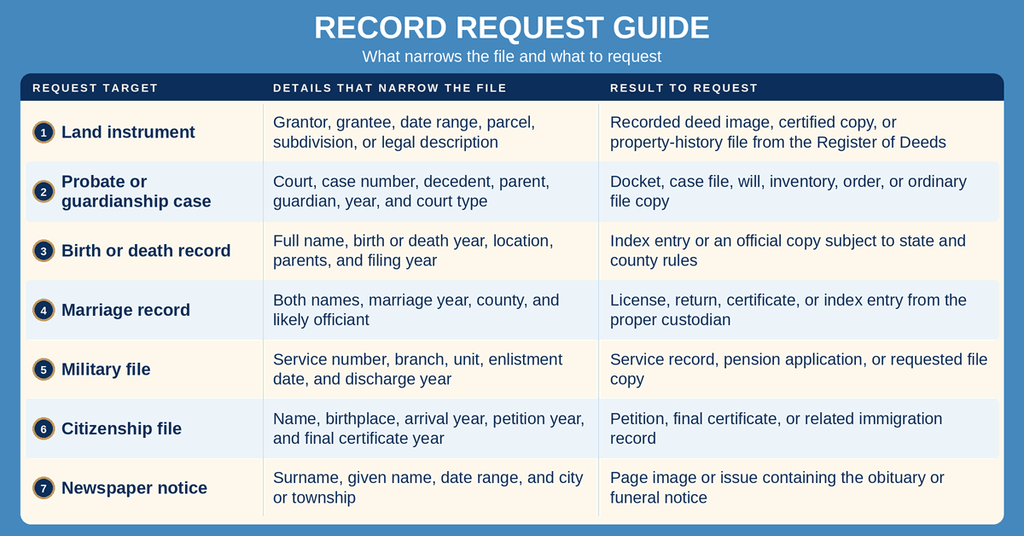
A written request should identify the jurisdiction, event type, full names, date range, and parent collection whenever known. A legal description helps with a deed request. A court case number helps with probate or divorce records. Service number, branch, and unit help with military files. Parents’ names and the filing year help with birth and death records. Fees, request forms, payment methods, and delivery choices vary by agency, so researchers should use the terms shown by the holding office at the time of request.
Restricted Historical Copies
Some historical material remains subject to privacy or handling rules. Recent birth and death records, certain adoption files, sealed court cases, juvenile matters, and records involving living people may have special limits. Donor agreements, copyright, court closure, or an unprocessed collection can also restrict copying. An index entry may be searchable even when the full image cannot be displayed.
An ordinary copy reproduces a document for research. A certified copy carries an agency’s authentication statement and is used when a legal, estate, or official purpose requires that level of proof. A scan marked as a copy does not become certified merely because it came from an archive. Requesters who need a specific copy type should state that requirement before payment.
Record Accuracy and Resolution
Genealogy record verification depends on reading the record itself. Index entries can contain spelling errors, shortened names, reversed given names, and estimated dates. Researchers should preserve the exact wording in a citation, then place their interpretation in separate notes. This practice makes later corrections possible and keeps an assumption from becoming a false family fact.
Variant Spellings and Name Changes
A spelling difference may come from handwriting, an indexer’s choice, an abbreviation, an accent, or a family’s actual use of several names. Compare the document image with nearby pages because one person may appear as William in one record and Wm. in another. Names such as Johnson and Johnsen may represent separate families rather than one family with changing spelling.
Formal name changes should be supported by a court or other legal record. A marriage record can introduce a married name without proving that all later records refer to a legal change. Add aliases with the date and source attached, and never replace the original name without retaining the earlier form for future searches.
Unindexed and Undigitized Archives
An unindexed file may still exist. Court records can be arranged by case number, probate records by decedent, deeds by grantor and grantee, school records by class year, and cemetery records by burial date or section. Searchers can browse these physical arrangements when names are missing or spelling changes are common. A finding aid can point to the right box, folder, reel, or bound volume.
Optical character recognition can misread handwritten names, faded type, abbreviations, and broken lines. If a search fails, try fewer terms, broader dates, and spelling variants, then inspect the surrounding page images. A note in a margin may identify a family that the index never captured. Repository staff can also check uncataloged holdings and records transferred from other offices.
Missing Ancestral Files and Conflicting Facts
A missing record has several possible causes: the event may not exist in that series, the name may differ, the date may fall outside the collection, the file may be stored under another person, or the original may have been lost. Researchers should define the missing item precisely before searching elsewhere. “No birth record for John Smith in 1902” is too broad; a request for a birth certificate filed in Sedgwick County in 1902 for a child named John, with named parents, is much more useful.
When two sources disagree, compare the disputed fact with each record’s purpose and date. A legal document may be strong evidence that a transaction or filing occurred, yet it may not settle a biological relationship. A later obituary may draw on family memory rather than the official event record. Keep both claims in the research log until more evidence resolves the difference.
- State the disputed name, date, place, or relationship in one sentence
- Read the full record rather than relying on an index entry
- Record the creator, purpose, filing date, and jurisdiction for each source
- Separate birth, baptism, marriage, burial, probate, and residence dates
- Check whether the record describes the event directly or repeats another person’s claim
- Look for a second source produced by a different office or witness
- Keep unresolved details as a range with citations, without averaging dates or inventing a value
- Correct the family tree only after the source trail supports the change
Contact Details
Use the following details for questions about the library’s local-history holdings and research services. The library is a research resource for Wichita and Sedgwick County history, not an official county obituary index.
Frequently Asked Questions
Find quick answers about locating and using genealogy records for Sedgwick County through the Wichita Public Library.
Where can I find Sedgwick County genealogy records?
The Wichita Public Library’s Advanced Learning Library houses a local‑history collection that includes Sedgwick County genealogy records. Visit the library at 711 W. 2nd St., Wichita, KS, or use the online portal at wichitalibrary.org/research/localhistory. The portal links to census schedules, city directories, cemetery indexes, court files, and newspaper archives. Staff can guide you to specific items and explain any access restrictions that may apply.
How to search birth records in Sedgwick County?
Start with the library’s Local History portal and select the “Birth Records” link. Choose the year range you need, then enter the surname or first name of the individual. The system returns scanned images or transcriptions when available. If a record is not digitized, note the call number and request a copy from a reference librarian. Remember that recent births may have privacy limits, so older records are more likely to be fully accessible.
What types of historical records are at Wichita Library?
The library’s collection includes federal and state census data, city directories, voter registrations, school enrollment lists, and property deeds. You will also find probate files, marriage and death certificates, cemetery records, and historic newspapers. Military service documents, immigration papers, and naturalization records are available in microform or digital format. Each group is organized by date and subject, making it easier to locate the exact file you need for family‑history research.
Can I do probate files online for Sedgwick County?
Yes. The library’s online catalog lists many Sedgwick County probate files that have been digitized. Search the catalog using “probate” plus the name of the person or the case number. When a file appears, click the link to view a PDF or image. If the file is not online, the catalog provides a call number for the physical copy. Librarians can arrange a scan or copy, though a small fee may apply for large requests.
How to verify a Sedgwick ancestor’s death date?
Begin with the library’s death‑record index, which can be searched by name and year. If the index matches, view the scanned death certificate for the exact date. Cross‑check the information with cemetery records or obituary listings available in the newspaper archive. When multiple sources agree, you have a reliable date. If records conflict, note each source and consider the one with official government stamps as the most authoritative.